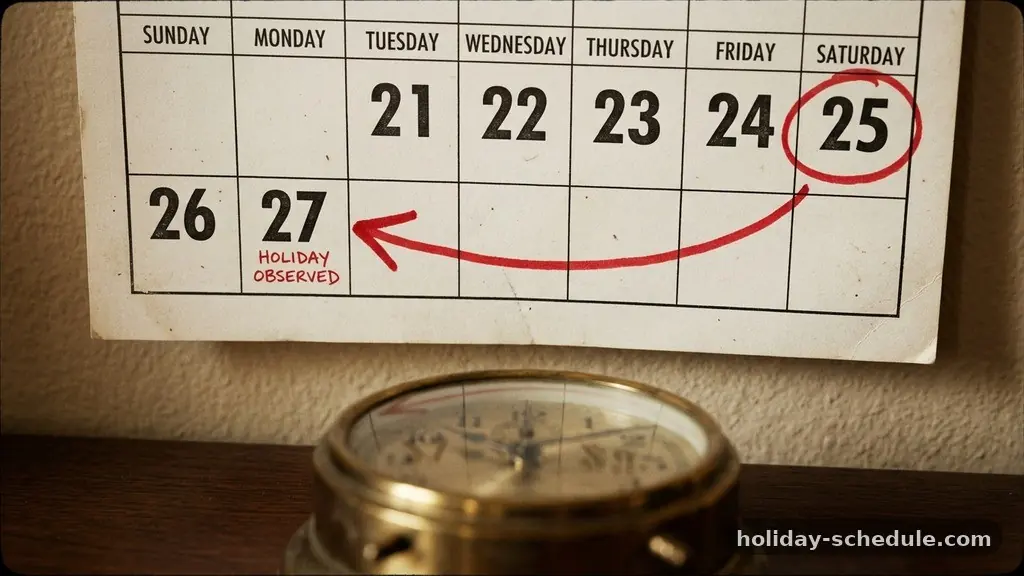
When you see a red date on your calendar, you might assume that is the exact day you will be off work. However, there is a distinct difference between the actual date of a commemoration and the day it is legally recognized for labor purposes. Having observed holidays explained helps you understand why your office might be closed on a Friday even though the holiday technically falls on a Saturday.
This distinction ensures that employees and employers stay aligned on pay schedules and time off. Understanding these shifts helps you plan your year effectively and avoids confusion when payroll or project deadlines approach.
The core reason for these shifts is simple: consistency and economic stability. When a holiday falls on a Saturday or Sunday, it risks being “lost” to the average worker who is already off. By shifting the recognition to a weekday, workers are guaranteed their day of rest or their premium holiday pay.
This practice prevents a situation where a holiday provides no tangible benefit to the workforce. It is a balancing act between honoring historical events and maintaining functional, predictable business operations.
The Mechanics of Holiday Shifting
At its most basic level, the shift occurs to prevent a weekend collision. If a fixed-date holiday like Independence Day falls on a Saturday, the government and private sector often designate the preceding Friday as the substitute holiday.
Conversely, if the holiday falls on a Sunday, the following Monday becomes the observed date. This practice is standard across federal and many private institutions to ensure everyone receives their entitled time off.
The Office of Personnel Management provides the specific rules for federal employees, which often set the standard for the rest of the country. When a holiday occurs on a Saturday, the Friday immediately preceding it is treated as the holiday for pay and leave purposes.
If it falls on a Sunday, the following Monday is designated as the day off. This prevents a “lost” holiday and ensures that the total number of paid days remains consistent year over year.
Federal Holidays and the OPM Standard
Federal holidays are the primary drivers of these shifts in the United States. While the law designates specific dates for these commemorations, the OPM guidelines dictate how those dates are handled when they fall outside the standard workweek.
This ensures that federal workers, who are governed by strict statutes, receive their mandated time off. Most private employers follow these federal conventions to maintain consistency with banking systems and the broader economy.
These rules are not merely suggestions; they are structural requirements for government operations. Because federal agencies must align with the Federal Reserve and other financial institutions, they cannot simply ignore a holiday that falls on a weekend.
By moving the observation, the government ensures that the financial sector remains in sync with the public sector. This predictability is vital for international commerce and domestic logistics.
Impact on Business Operations and Payroll
For private businesses, the decision to observe a holiday on a different day often comes down to internal policy and labor laws. While the Fair Labor Standards Act does not mandate paid time off for holidays, most companies offer it as part of a competitive benefits package.
Employers must decide whether to follow the federal “observed” date or to stick to the actual calendar date. Most choose the federal path to avoid confusion with banks and suppliers.
Payroll departments must be particularly careful with these adjustments. If an employee works on an observed holiday, they may be entitled to premium pay, often referred to as “holiday pay.”
If the company observes the holiday on a Monday instead of the actual Sunday, the Monday becomes the day for premium compensation. Failing to account for this can lead to wage disputes and compliance issues.
Distinguishing Statutory vs. Observed Holidays
A statutory holiday is the date fixed by law, such as December 25th for Christmas. An observed holiday is the specific day the government or a company designates for the closure.
Sometimes these two dates align perfectly, and other times they are separated by one or two days. This distinction is crucial for understanding why your local bank might be closed on a Monday for a holiday that actually occurred on a Sunday.
The following table illustrates how these shifts typically function for a standard workweek.
| Holiday Date | Calendar Day | Observed Day |
|---|---|---|
| July 4th | Saturday | Friday, July 3rd |
| January 1st | Sunday | Monday, January 2nd |
| November 11th | Tuesday | Tuesday, November 11th |
| December 25th | Friday | Friday, December 25th |
The Role of the Monday Holiday Act
The Uniform Monday Holiday Act of 1968 was a major milestone in how we view these dates. This legislation shifted several commemorations to specific Mondays to ensure three-day weekends for the workforce.
Holidays like Presidents’ Day and Memorial Day were permanently moved to Mondays to provide a more predictable schedule. This act fundamentally changed the American calendar and reduced the frequency of mid-week interruptions.
Before this act, holidays were fixed to specific dates regardless of the day of the week. This often caused “hump day” closures that disrupted productivity and made long-term planning difficult.
By anchoring these celebrations to Mondays, the government created a system that balances national remembrance with economic efficiency. This transition highlights the government’s willingness to prioritize worker well-being alongside business functionality.
Managing Compensatory Time and Floating Holidays
Many companies offer floating holidays to give employees more flexibility. A floating holiday allows a worker to choose their day off, which solves the problem of a fixed holiday falling on a weekend.
If a business remains open on an observed holiday, they might offer compensatory time instead. This means the employee gets a different day off later in the year, effectively banking the time for later use.
This approach is popular in high-demand industries like healthcare or retail. These sectors cannot simply shut down because of a calendar date.
By using compensatory time or floating days, they ensure that the total amount of paid time off remains fair. It allows the business to maintain essential services while still honoring the spirit of the holiday for their staff.
Common Misconceptions About Holiday Pay
One of the most persistent myths is that federal law requires employers to provide paid time off for holidays. In reality, the Fair Labor Standards Act is silent on the matter of holiday pay.
It is entirely up to the employer to decide if they will pay for time not worked. Most companies do provide this as a perk, but it is a contract-based benefit, not a legal requirement.
Another misconception is that an employee is entitled to “double time” if they work on a holiday. Again, federal law does not mandate this.
Premium pay for working on a holiday is a matter of company policy or collective bargaining agreements. Always check your employee handbook to see how your specific organization handles these instances.
Frequently Asked Questions
Does the government require private companies to follow federal observed dates?
No, the government does not mandate that private businesses follow federal holiday schedules. Most companies align with the federal calendar voluntarily to ensure their operations match those of their banks, clients, and suppliers.
What happens if I work on an observed holiday?
Whether you receive extra pay depends on your company’s internal policies or your employment contract. Federal law does not require additional compensation for working on a holiday, though many employers offer it as a voluntary benefit.
Can an employer force me to work on a holiday?
Yes, in the private sector, employers generally have the right to require work on holidays. Unless you have a specific employment contract or union agreement stating otherwise, your employer can set the schedule as needed for business operations.
Why do some holidays stay on the same date while others move?
Holidays that are tied to specific historical anniversaries, like Independence Day, remain on their calendar date unless the government mandates a shift to a weekday for observation. Other holidays, like Labor Day, are defined by their weekday position, such as “the first Monday in September,” so they never move.
How do I know if my company observes a holiday?
Your best source of information is your company’s employee handbook or human resources department. They will outline which days the office is closed and how they handle holidays that fall on weekends.
Conclusion
Navigating the complexities of the calendar is an essential part of professional life. With observed holidays explained, you can see that these shifts are designed to provide balance between necessary business operations and the well-deserved rest of the workforce. Whether you are managing a team or planning your own vacation time, understanding these rules prevents unnecessary stress and ensures you don’t miss out on your benefits.
Remember that while federal guidelines set a standard, your specific workplace policies remain the final word on your schedule. Take a moment to review your company’s holiday calendar early in the year to avoid any surprises.
By staying informed about how these dates are managed, you can better align your personal time with the rhythm of the business year. Planning ahead is the simplest way to enjoy your time off without any professional friction.